Doctor–Patient Video Consultations
Potential Solution
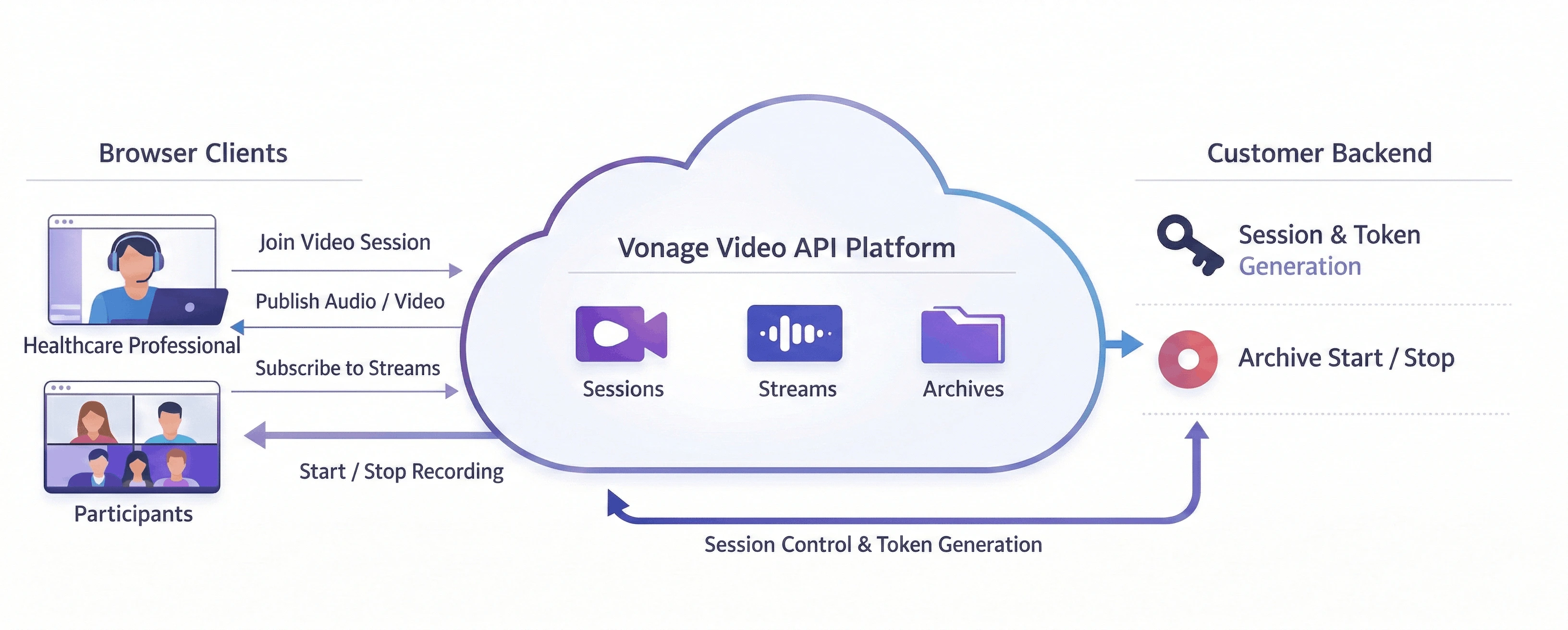
A telehealth platform powered by the Vonage Video API’s one-to-one and multi-party video capabilities enables healthcare organizations to deliver secure, seamless, and personalized virtual care at scale.
At a high level,
- Session access and roles: Create a session on your server and issue tokens per participant with the appropriate role and an expiration time. Roles determine what a participant can do in the session.
- Client experience: Use the Vonage Video client SDKs to connect, publish, and subscribe within your application. For a web-based multiparty conferencing UI, Vonage Video Express is a JavaScript library that works on top of OpenTok.js. See the Video Express Developer Guide.
- Optional capabilities: Implement recording and playback, post-call transcription, live captions, screen sharing, server-side session monitoring, and in-session data messaging.
Key Features:
With Vonage Communications APIs, organizations can deliver a fully integrated, compliant telehealth solution that builds patient trust, improves access to care, and streamlines clinical operations.
- Clinical-grade virtual consultations: Deliver reliable, low-latency video for clear doctor–patient communication across primary care, dermatology, behavioral health, and specialty services.
- Integrated, collaborative care workflows: Embed consultations directly in EMRs, patient portals, or mobile apps, and support multi-party visits with specialists, family members, interpreters, and care coordinators.
- Secure and inclusive by design: Provide encrypted, HIPAA-aligned communications with role-based access and fraud protection, while supporting patients across devices and varying bandwidth conditions to expand equitable care access.
Benefits
| Category | Impact |
|---|---|
| Quality of Care | Real-time video enables accurate assessments, stronger patient–provider relationships, and improved outcomes. |
| Operational Efficiency | Integrated video reduces manual coordination, eliminates tool-switching, and accelerates clinical workflows. |
| Patient Experience | Secure, convenient access to care from any device increases satisfaction and reduces no-shows. |
| Security & Compliance | HIPAA-aligned security, encryption, and access controls safeguard PHI and reduce breach risk. |
| Access & Equity | Virtual care expands access for rural, mobility-limited, and underserved populations. |
| Scalability | APIs support rapid expansion from small practices to large health systems across multiple specialties. |
| Brand & Trust | A fully integrated, secure telehealth experience strengthens patient confidence and reinforces provider reputation. |
Conclusion
Telehealth is now a foundational element of healthcare delivery. A telehealth app powered by the Vonage Video API’s one-to-one and multi-party video capabilities creates a secure, seamless, and patient-centric virtual care environment. It enables providers to close care gaps, improve clinical outcomes, enhance patient trust, and meet growing expectations for convenient and HIPAA-aligned digital care.
By building an integrated solution rather than relying on fragmented communication tools, healthcare organizations position themselves to deliver high-quality care anywhere, on any device, and at any scale—strengthening their strategic position in today’s digital-first healthcare landscape.