Digital Login for Silent Authentication
Executive Summary
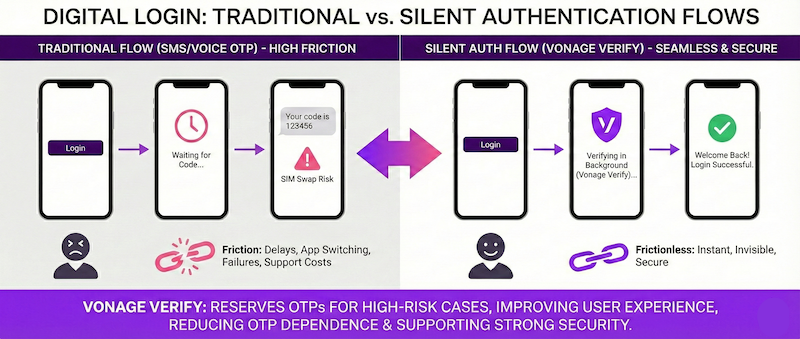
Many digital services verify returning users by sending one-time passcodes (OTPs) via SMS or voice call. While familiar, this method may result in a poor login experience and blocks access for a significant number of users due to OTP delivery failures or delays. Users might have to wait for messages, switch between apps, or attempt to enter codes that never arrive. These interruptions create frustration, abandoned transactions, and increase both long-term support and operational costs.
Organizations across sectors, such as SaaS, E-commerce, Media, Healthcare, and Financial Services, must protect their users against threats like SIM swap attacks while still delivering a login experience that feels effortless. In any high-frequency login environment, repeated OTP prompts slow users down, reduce engagement, and create unnecessary frustration.
By implementing Vonage Verify Silent Authentication, organizations can allow low-risk logins on eligible devices to complete smoothly and securely, with OTP used only for higher-risk cases. This approach improves the overall user experience, reduces OTP dependence, and supports strong security standards across industries.
Market Opportunity
Today, companies handle millions of logins each month, and customers expect quick, seamless, and effortless access, particularly on mobile devices. Waiting for SMS codes or resolving incorrect entries can make the login process lengthy and frustrating. These issues intensify during peak activity periods, such as sales events, product launches, or holiday traffic, when OTP systems are under maximum strain. They are also more pronounced in high-value interactions, such as financial transfers, and in regions where SMS reliability is inconsistent. At such moments, friction directly contributes to process abandonment, lost revenue, and increased support demand.
The OTP-heavy authentication flows create a clear opportunity to:
- Improve login verification for returning customers by automating low-risk cases.
- Reduce long-term support and operational costs by minimizing OTP usage and delivery dependencies.
- Improve security standards for low-risk logins by validating returning users with background checks that require no user action.
Problem Statement
OTP delivery failures disrupt logins, causing user frustration and operational overhead, while Silent Authentication can prevent these delays for eligible devices and sessions.
Supporting challenges:
- Slow and frustrating login experiences: Customers may wait for SMS or voice codes or switch between apps to retrieve them.
- Login failures: Codes may not arrive, so customers need to retry or resend messages.
- OTP fatigue & wrong OTP entry: Customers may need to repeatedly enter codes, which can become tiring, especially during frequent logins. It also increases the risk of incorrect OTP entry due to manual effort.
- Higher support and operational costs: Increased reliance on SMS or voice OTPs increases long-term verification expenses and leads to increased support cases due to verification failures.
- Exposure to fraud: Attackers may log in using SIM-swapped numbers.