Digital Onboarding with Silent Authentication
Potential Solution
If the organizations want to improve digital onboarding outcomes, they must reduce flow fragmentation for legitimate users while preserving strong security controls across diverse industries and user journeys. This can be accomplished by using Vonage Verify Silent Authentication as the default verification method for low-risk customers, with organized fallback options as necessary. Consequently, OTPs should only be used for high-risk scenarios that demand further verification.
Note: Fallback channels can be any Verify workflow option (for example, SMS, Voice, WhatsApp, RCS, or Email). SMS and Voice are shown in this use case only as examples. For details, see Verify workflows.
Silent Authentication verifies a phone number directly with the mobile carrier using mobile network verification. It functions in the background, removing the need for users to input passwords, provide verification information, or recall OTPs. As the verification takes place over the carrier network, it improves confidence that the phone number corresponds to the device used during the onboarding process. Silent Authentication can be easily integrated into any business using the Vonage Verify API.
The following flow is our suggested method for implementation:
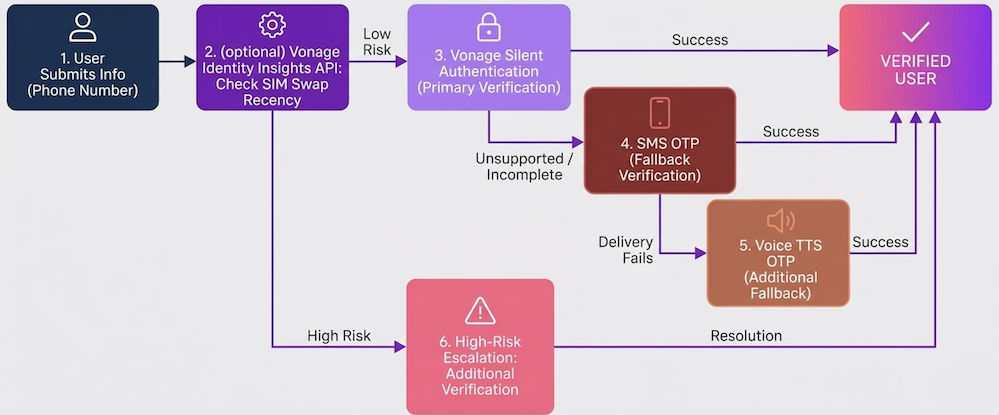
The Vonage Verify Silent Authentication solution effectively addresses the long-standing trade-off between security strength and onboarding completion. Without it, organizations often face a trade-off between applying high-friction verification to all users or relying on less reliable verification methods for low-risk scenarios.
Benefits
The Vonage Verify Silent Authentication solution delivers measurable value across key categories:
| Category | Impact |
|---|---|
| Customer Experience & Growth | Faster, smoother onboarding experiences reduces flow fragmentation and abandonment, leading to higher signup completion rates and increased initial user engagement. |
| Security | More reliable verification of a phone number reduces fraud risk and protects brand reputation and trust. |
| Operational Efficiency | Lower verification overhead and reduced OTP dependency. |
| Technical Reliability | The multi-layer fallback (Silent Auth > SMS > Voice) enhances overall verification success rates and minimizes failed onboarding flows. |
Strategic Advantage
The Vonage Verify Silent Authentication solution provides long-term strategic advantages for organizations operating digital onboarding flows:
- Reduced Time-to-Value (TTV): It removes unnecessary friction at the first interaction, increasing the likelihood that new users complete onboarding.
- Security & Trust: It strengthens early-stage security by reducing common onboarding-related fraud vectors and building customer confidence.
- Brand Perception: It reinforces brand authority by combining strong protection with a seamless first-time user experience.
- Monetization & Scalability: Background authentication scales across global markets by reducing the operational and deliverability costs associated with high-volume manual SMS delivery.
- Lifecycle Retention: Silent Authentication provides a decisive advantage beyond onboarding. It can also be used for returning users.
Conclusion
As digital onboarding becomes a primary acquisition channel, organizations need to find the right balance between speed and security. Vonage Verify Silent Authentication provides the approach that aligns with modern user expectations and maintains strong protection. It prioritizes background verification for low-risk onboarding and reserves OTPs for exceptional cases only. This strategy allows companies across various industries to transform onboarding from a barrier into a competitive advantage.