Retail Banking Login with Silent Authentication
Executive Summary
Mobile banking applications are used for frequent, short interactions, such as checking account balances or reviewing recent transactions. Many customers log in to their mobile apps multiple times a week to monitor their accounts. Although many login sessions involve routine account checks, unauthorized access to financial accounts carries significant fraud and reputational risk, leading banks to rely heavily on OTP-based verification. However, OTP-based login flows introduce delivery dependencies that can disrupt legitimate access while not fully addressing risks such as SIM-swap-related account takeover.
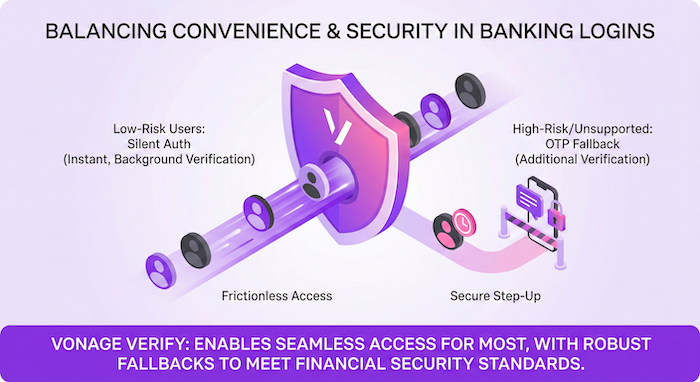
By implementing Vonage Verify Silent Authentication for low-risk banking logins, financial institutions can verify phone number ownership in the background on eligible devices. It allows customers to access their accounts smoothly without manual input. If Silent Authentication is not supported or if there are indicators of risk, OTP verification can serve as a fallback. This approach results in a more efficient login experience that balances user convenience with the security requirements essential to financial services.
Market Opportunity
Retail banking applications handle extremely high login volumes, with customers accessing their accounts multiple times per week to check balances, monitor transactions, or review account activity. Failures in OTPs due to delayed SMS delivery, roaming issues, or coverage limitations can prevent legitimate users from accessing their accounts.
This creates an opportunity to:
- Increase login success rates by reducing reliance on SMS and voice OTPs.
- Adopt risk-based login verification that adapts security levels based on session context.
- Lower operational and messaging costs by decreasing OTP delivery for routine access scenarios.
- Reduce login-related support cases caused by failed or delayed OTPs.
- Strengthen customer trust by delivering a login experience that feels both secure and seamless.
Problem Statement
Mobile banking applications are designed for frequent, short interactions. As a precaution against account takeover, some institutions continue to rely heavily on OTP-based step-up verification for routine mobile logins, regardless of session context. This reliance on OTPs can create friction and access issues, ultimately leading to a degraded user experience.
Key challenges:
- OTP delivery failures & login delays: Delayed or missing SMS or voice messages can block legitimate users from accessing their accounts.
- Overreliance on OTPs: While widely used, SMS-based verification can be affected by delivery limitations and does not independently assess SIM-swap exposure before granting access.
- Reduced engagement: Friction during everyday access may discourage regular app usage.
- Operational overhead: Failed OTP logins increase the need for recovery processes and involve more support.