Digital Login for Silent Authentication
Potential Solution
To improve the login experience and better serve customers, companies should reduce friction for returning users while maintaining strong security measures; this can be accomplished by adopting Vonage Verify Silent Authentication as the standard verification method for low-risk customers, with well-defined fallback options if necessary.
Note: Fallback channels can be any Verify workflow option (for example, SMS, Voice, WhatsApp, RCS, or Email). SMS and Voice are shown in this use case only as examples. For details, see Verify workflows.
Silent Authentication uses mobile network verification to validate a phone number directly with the mobile carrier. It runs in the background, eliminating the need for users to enter passwords or remember OTPs. Because verification takes place over the carrier network, it provides network-level confirmation that the mobile number is actively associated with the device initiating the request. Silent Authentication can be readily integrated into any business using the Vonage Verify API.
The following flow is our suggested method for implementation:
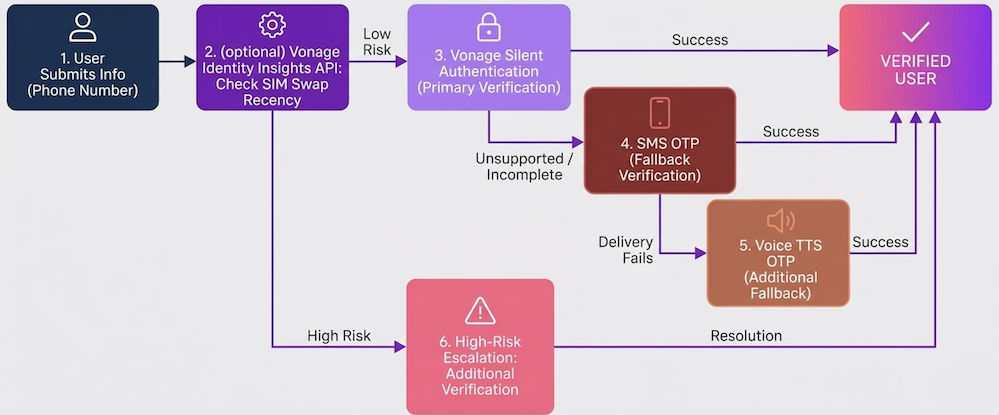
The Vonage Verify Silent Authentication solution effectively resolves the important conflict between security and user satisfaction. It enables a frictionless login path for eligible sessions, which improves user satisfaction, lowers support costs, and strengthens security by reserving OTP for high-risk verifications. Without this solution, organizations face a difficult choice: they can either impose clunky authentication processes on every user, leading to decreased satisfaction, or they can apply weak security measures universally, which poses a significant risk.
Benefits
The Vonage Verify Silent Authentication solution delivers a powerful value across key categories:
| Category | Impact |
|---|---|
| Customer Experience & Efficiency | Faster and smoother login process reduces friction and drop-offs, resulting in improved user satisfaction and reduced login abandonment. Additionally, there is less load on support and recovery channels. |
| Security | More reliable verification of a phone number reduces fraud risk and protects brand reputation and trust. |
| Cost Reductions | Fewer OTPs result in lower messaging or voice transaction expenses and decrease the volume of customer support cases related to failed or delayed codes. |
| Operational Efficiency | Lower verification overhead and reduced OTP dependency. |
| Technical Reliability | The multi-layer fallback (Silent Auth > SMS > Voice) enhances overall verification success rates and minimizes failed login flows. |
Strategic Advantage
The Vonage Verify Silent Authentication solution provides strategic value across key areas:
- Acquisition & Market Share: It serves as our flagship differentiator, accelerating customer acquisition by offering the smoothest login experience in the market.
- Compliance & Efficiency: It supports regulatory compliance by reducing friction in low-risk authentication flows.
- Security & Trust: It strengthens mobile authentication posture, reducing exposure to common OTP-related fraud vectors.
- Cost Efficiency: By reducing OTP volume and minimizing login-related support issues, Vonage Silent Authentication lowers operational costs. It enables verification flows to scale without the proportional cost increases associated with SMS or voice transactions.
- Monetization: It reduces interruptions during payments or data access with an OTP, directly undermining revenue and customer confidence.
- Daily Use & Retention: It minimizes friction in mobile experiences, creating a decisive advantage for competitors with smoother authentication.
Conclusion
The Vonage Verify Silent Authentication improves the login process for legitimate users while enhancing protection against fraud. By reducing reliance on OTPs, organizations can improve user satisfaction, reduce operational and support costs, and maintain strong security. These benefits apply across a wide range of digital industries, helping organizations strengthen trust, increase retention, and support long-term growth.