Digital Onboarding with Silent Authentication
Executive Summary
Digital onboarding is an important moment for any organization. It determines whether a prospective user becomes a customer. It is the first interaction between an organization and a new user that directly shapes trust and conversion.
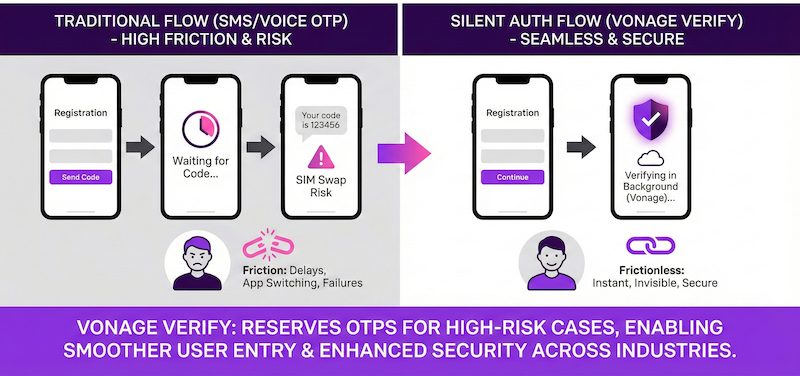
Many onboarding flows rely on One-Time Passwords (OTPs) sent via SMS or voice calls to verify phone numbers. This process often requires waiting for messages, switching applications, or repeating failed verification attempts before gaining access. Additionally, security threats, such as SIM swap attacks, complicate onboarding further.
Vonage Verify Silent Authentication applied in low-risk onboarding scenarios, allows organizations to verify phone number ownership in the background and reserve OTPs for higher-risk cases. Thanks to this approach, organizations across multiple digital-first industries can achieve more secure onboarding with less friction for new users.
Market Opportunity
Nowadays, more organizations shift customer acquisition to digital channels. As a result, onboarding stops being just an administrative step and becomes a significant conversion point. Consumer apps, subscription services, and e-commerce platforms, where speed and simplicity are essential, shape user expectations for digital onboarding. As identity fraud techniques evolve, organizations must improve security without increasing customer effort.
This scenario creates an opportunity to:
- Modernize onboarding by implementing background verification for low-risk cases, enabling smoother experiences for first-time users.
- Improve identity verification for low-risk customers by eliminating the need for intermediaries.
- Create a unified verification strategy that works regardless of the user's location or device type.
Problem Statement
Companies commonly use OTP-based verification during digital onboarding. However, this method often creates flow fragmentation at the crucial early stages of the user journey.
Key challenges:
- Flow fragmentation during onboarding (when users are forced to leave the app to complete verification): Switching from the app to the SMS inbox breaks the "session state" and leads to technical drop-offs.
- Abandonment risk: Friction during the initial signup increases the likelihood that users will leave before completing account creation.
- Weak identity assurance: SMS or voice call OTPs confirm only that the device can receive a message at that moment, not that the phone number actually belongs to the applicant.
- Fraud exposure: Individuals attempting to commit fraud may onboard using SIM-swapped numbers or numbers that are not associated with their true identity.