Banking Digital Onboarding with Silent Authentication
Executive Summary
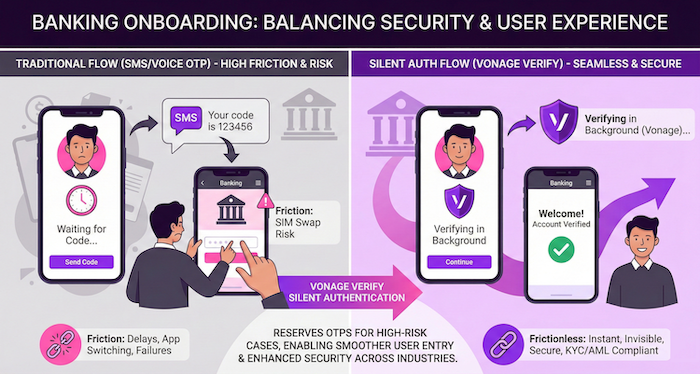
Financial institutions, including banks, must meet strict Know Your Customer (KYC) and Anti-Money Laundering (AML) requirements while ensuring that digital customer onboarding remains quick and user-friendly. Today, many banks rely on using one-time passcodes (OTPs) sent via SMS or voice call to verify a customer's phone number.
The challenge is most visible during new-user registration, where the onboarding process creates both the customer's first impression and the bank's main conversion funnel. Any friction (waiting for SMS codes, delivery failures, or switching between apps) can significantly reduce completion rates. Similar issues may occur during logins or when performing high-risk actions.
Additionally, OTPs verify control of the SIM at a moment in time but offer limited insight into whether the person onboarding is the rightful owner of the number. This gap is especially risky in cases of SIM swaps, where an attacker, not the applicant, may receive the OTP. Banks not only need to ensure that the phone number matches the applicant, but also that the applicant is legitimate through separate KYC and AML processes.
Because many onboarding processes default to OTP, Silent Authentication is rarely the primary step. However, implementing Vonage Verify Silent Authentication in the business can directly address the critical tension between security and user conversion. It provides a frictionless primary verification experience while supporting compliance processes, improving conversion, and enhancing customer satisfaction. This solution is especially valuable in Finance. However, it can be profitable in all regulated or high-stakes industries such as Healthcare and Enterprise Software as a Service (SaaS).
Market Opportunity
Customers increasingly expect digital services to be seamless, smooth, and secure. They desire processes that require minimal effort and are free of interruptions or delays. During account creation, the onboarding process is an integral part of a new customer’s experience as it shapes their first impression. Lengthy verification steps, such as waiting for SMS codes or correcting failed manual entries, can cause friction and lead to abandoning the process. At the same time, concerns about fraud and the need for strong identity assurance, may influence how banks design onboarding flows.
This scenario creates a clear opportunity for financial institutions to:
- Improve onboarding completion and conversion rates by streamlining low-risk verification with faster, automated methods.
- Strengthen identity validation for low-risk customers by eliminating the need for intermediaries, reducing reliance on OTPs, and minimizing user effort.
Problem Statement
Onboarding processes relying primarily on OTPs create friction that reduces completion rates, limits identity assurance, and exposes banks to fraud, while Silent Authentication is underutilized.
Supporting challenges:
- Drop-off risk: Customers may experience delays when waiting for SMS or voice call codes, switching apps, or attempting to resend failed messages. All of this can slow down the onboarding process and create friction.
- Limited identity assurance: SMS or voice call OTPs only confirm that a device can receive a message at that moment, but they do not offer reliable assurance that the phone number actually belongs to the applicant.
- Exposure to fraud: Individuals attempting to commit fraud may onboard using SIM-swapped numbers, or numbers that are not associated with their true identity.