
Share:
)
Liz Acosta is a Developer Advocate at Vonage. While her career path from film student to marketer to engineer to Developer Advocate might seem unconventional, it’s pretty typical for Developer Relations! Liz loves pizza, plants, pugs, and Python.
Women+ in Open Source Day: Community and Code at Snowflake
Time to read: 7 minutes
To celebrate International Women’s Day on March 8th, 2026, we produced a short video celebrating the contributions of women in tech. Our video highlights pioneers who significantly shaped computing, software, networking, and artificial intelligence — often without receiving recognition.
We wanted to help change that by naming some of our favorite innovators and what they did:
Ada Lovelace is often called the world’s first computer programmer. In the 1840s – long before modern computers existed – she imagined how machines could go beyond simple calculations. She wrote what’s considered the first published algorithm designed for a machine. Even more remarkably, she predicted that computers could one day create music and art. Turns out she was right!
Grace Hopper helped make programming accessible to humans. She was instrumental in developing early compilers and played a major role in the creation of COBOL, one of the first widely used programming languages. Her belief that computers should understand human-readable instructions changed software development forever. She’s also responsible for a term that developers use every day: “debugging.”
Margaret Hamilton led the team that developed the onboard flight software for NASA’s Apollo missions. During the Apollo 11 moon landing, her software prioritized critical tasks and prevented a mission abort. Her work didn’t just help land humans on the moon — it helped establish software engineering as a serious, disciplined field. That one small step for a man was made possible by the great strides of a woman.
Radia Perlman invented the Spanning Tree Protocol, which allows Ethernet networks to function reliably at scale. Without her work, modern networking infrastructure — including much of the internet — would not operate the way it does today. She is often called the “Mother of the Internet,” though she humbly resists the title.
Fei-Fei Li helped spark the modern AI revolution through her work on ImageNet, a massive visual database that enabled breakthroughs in computer vision. By giving machines the ability to better “see” and recognize images, her work accelerated advances in artificial intelligence that power technologies we now use daily.
The day after International Women’s Day, I attended the Women+ in Open Source event hosted at Snowflake’s Silicon Valley AI Hub in Menlo Park. The morning started off strong, with an inspiring keynote from Ruth Suehle, president of the Apache Software Foundation. Titled “Repeat or Re-weave? The Future of Women in Open Source,” Ruth started her talk with a provocative exercise, asking the audience to raise their hands if they’ve contributed code to an open source project and then asking for another show of hands for people who have contributed documentation or design to an open source project.
If that distinction between code and other types of contributions gives you pause, you wouldn’t be the only one.
Ruth then introduced “the flip.” The flip refers to a phenomenon in which work that is initially predominantly practiced by women – and therefore undervalued – is commandeered by men, who then professionalize the work. From beer brewing and textiles to education and medicine, work that was once considered domestic or informal became prestigious and profitable once men started practicing it. Ruth called this foreshadowing to an issue that plagues modern tech and the motivation for the day’s event: Who gets to be considered “technical” and therefore worthy of prestige and pay.
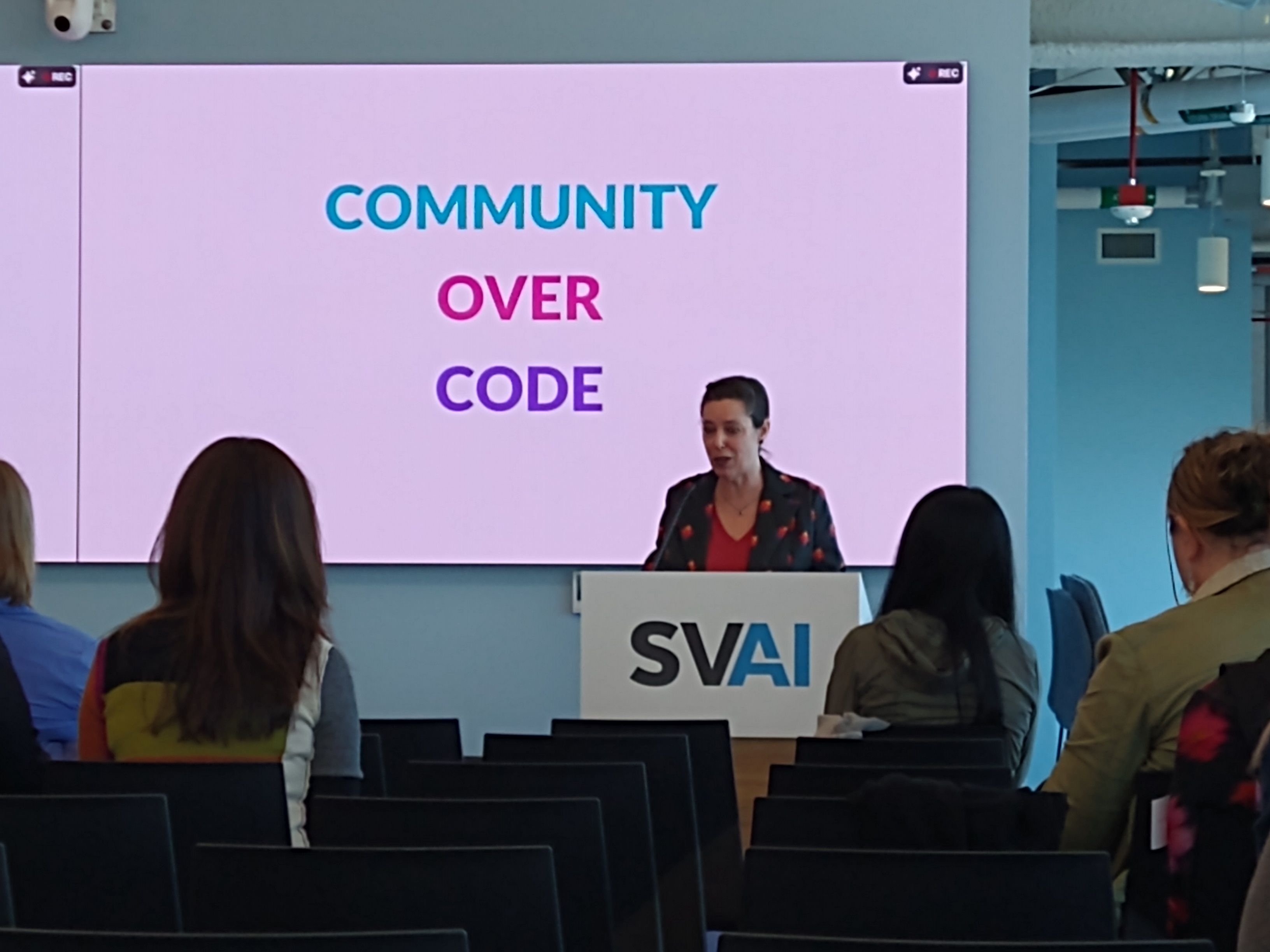 Ruth Suehle emphasizes the role of community in open source at the Women+ in Open Source Day at the SVAI Hub.The most intriguing part of the keynote was a reference to an April 1967 issue of Cosmopolitan comparing programming to making dinner. In the article, called “The Computer Girls,” Dr. Grace Murray Hopper (yes, that Grace Hopper) comments, “It’s just like planning a dinner … You have to plan ahead and schedule everything so it’s ready when you need it. Programming requires patience and the ability to handle detail. Women are ‘naturals’ at computer programming.” Naturally, the article was accompanied by a quiz: a mini “computer girl” aptitude test.
Somewhere along the continued development of computers from punch cards to pocket devices, the role of a programmer shifted from “low-level clerical workers” to “black magic wizards” to “curt, antisocial” male nerds – a far cry from the beehived “computer girls” of the 60’s.
As was foreshadowed.
But, according to Ruth, open source offers a way to prevent “the flip” – a mission that is even more critical, especially as the biases of AI become apparent. Ruth proposed that in order to erase the divide between what is considered “technical” and what is considered “non-technical” (but is as equally as important as writing code), there are three pillars to focus on:
Mentorship and guidance
Accurate contribution metrics
Recognition and compensation for all work that helps an open source project deliver value
Ultimately, community lies at the heart of a successful open source project. After all, Ruth concluded, “A good community can fix bad code and a bad community can ruin good code.”
For the second half of the day, we were invited to try our hand at contributing to one of the open source projects represented at the event. I sat with Holden Karau, a significant contributor to Apache Spark and advocate for open source, and attempted to address SPARK-52054 while Holden and I discussed eco-friendly glitter eye shadow. Unfortunately, I ran into some issues trying to get the project to build within the allotted time, but even that experience highlighted an opportunity to improve the project’s contributor guide.
As the day wound down into a happy hour basking in the glow of a sunset over the San Francisco Bay, I spoke with developers at various stages of their careers and with friends I’ve met over the years as a developer advocate. These days, the tech industry feels so much different from the one I entered after attending a women’s coding bootcamp, but that seems to be par for the course for a profession that was once considered secondary and almost invisible. Despite some of the uncertainty, I felt comforted by the camaraderie I was able to find that day in Silicon Valley. With its emphasis on community, open source offers a pathway to a future of programming where all contributions are valued equally.
If you’re feeling as inspired as I am to get more involved in open source, check out the Vonage MCP tooling server along with this handy guide to contributing to the project.
International Women’s Day is a time to recognize the pioneers who helped shape modern computing and to reflect on how the tech industry can continue building a more inclusive future. From Ada Lovelace’s early vision of programmable machines to Radia Perlman’s foundational networking work and Fei-Fei Li’s contributions to modern AI, the influence of women in technology spans generations of innovation.
At the Women+ in Open Source event hosted at Snowflake’s Silicon Valley AI Hub, developers and advocates gathered to explore how open source communities can ensure that all contributions — from code to documentation and design — are valued equally. Through an inspiring keynote, hands-on collaboration, and conversations with fellow developers, the event highlighted the power of community to support new contributors and challenge long-standing assumptions about what counts as “technical” work.
As open source continues to shape the future of software, fostering inclusive communities will remain essential. By recognizing the diverse contributions that sustain open source projects, the tech community can ensure that innovation remains collaborative, accessible, and representative of everyone who helps build it.
Join the Vonage DevRel Team in Celebrating IWD 2025: For International Women’s Day in 20215, we celebrated with a roundtable discussion about the issues women face in the tech industry today.
Attending Tech Conferences With a Toddler: A DevRel Mom’s Story: What it’s like to be a traveling mom in developer relations, inspired by questions asked at tech conferences.
Introducing MCP: AI Meets Programmable Communications With Vonage: An introduction to what an MCP is and Vonage's new MCP Servers.
The Vonage Server and Tooling MCP Servers Are Live on Postman: The Vonage Documentation and Tooling MCP Servers arrive on Postman.
4 MCP Lessons in Under 90 Seconds: Four essential lessons for mastering the Model Context Protocol.
Have a question or want to share what you're building?
Subscribe to the Developer Newsletter
Follow us on X (formerly Twitter) for updates
Prefer video? Watch tutorials on our YouTube channel
Connect with us on the Vonage Developer page on LinkedIn
Help us improve our developer experience by filling out our Voice of the Developer Feedback
Stay connected and keep up with the latest developer news, tips, and events.